From Sedentary Strain to Active Recovery During the Workday

Between deep focus at the screen and back-to-back meetings, online and in meeting rooms, many of us spend most of the workday in the same static positions. The problem isn't sitting down. The problem is the lack of variation and active recovery during the day.
What happens in the body when we sit still for too long?
When we hold the same working position for hours, a series of reactions sets in:
Circulation slows down. When the leg and gluteal muscles are at rest, the muscle pump isn't working and blood flow drops. That can mean heavy legs and cold hands and feet. Long stretches without breaks also affect metabolism: in one trial, adults with overweight had lower blood sugar and insulin after a meal when they broke up their sitting with two minutes of light walking every 20 minutes than when they sat without interruption.
The hips get stiff. When we sit, the hip flexors are shortened while the glutes are passive. After a long time in the same position, the hips and lower back can feel stiff when we stand up.
The neck and upper back lock up. Screen work and meetings pull the shoulders forward and the head out in front of the body — popularly called "tech neck." The further forward the head goes, the more the neck and shoulder muscles have to hold, which can lead to tension headaches and sore muscles.
Breathing becomes shallow. A slumped sitting posture restricts the movement of the diaphragm, so we breathe higher up in the chest. That's the opposite of the calm breathing that helps the body settle down.
A few minutes during the workday make a difference
The answer isn't necessarily an hour of hard training after work. Research from the Danish National Research Centre for the Working Environment (NFA) shows that short exercise breaks during working hours can reduce neck and shoulder pain. In one trial, even two minutes a day of strength training with an elastic band reduced pain after ten weeks. So it doesn't have to take more than 3–5 minutes a day to make a difference.
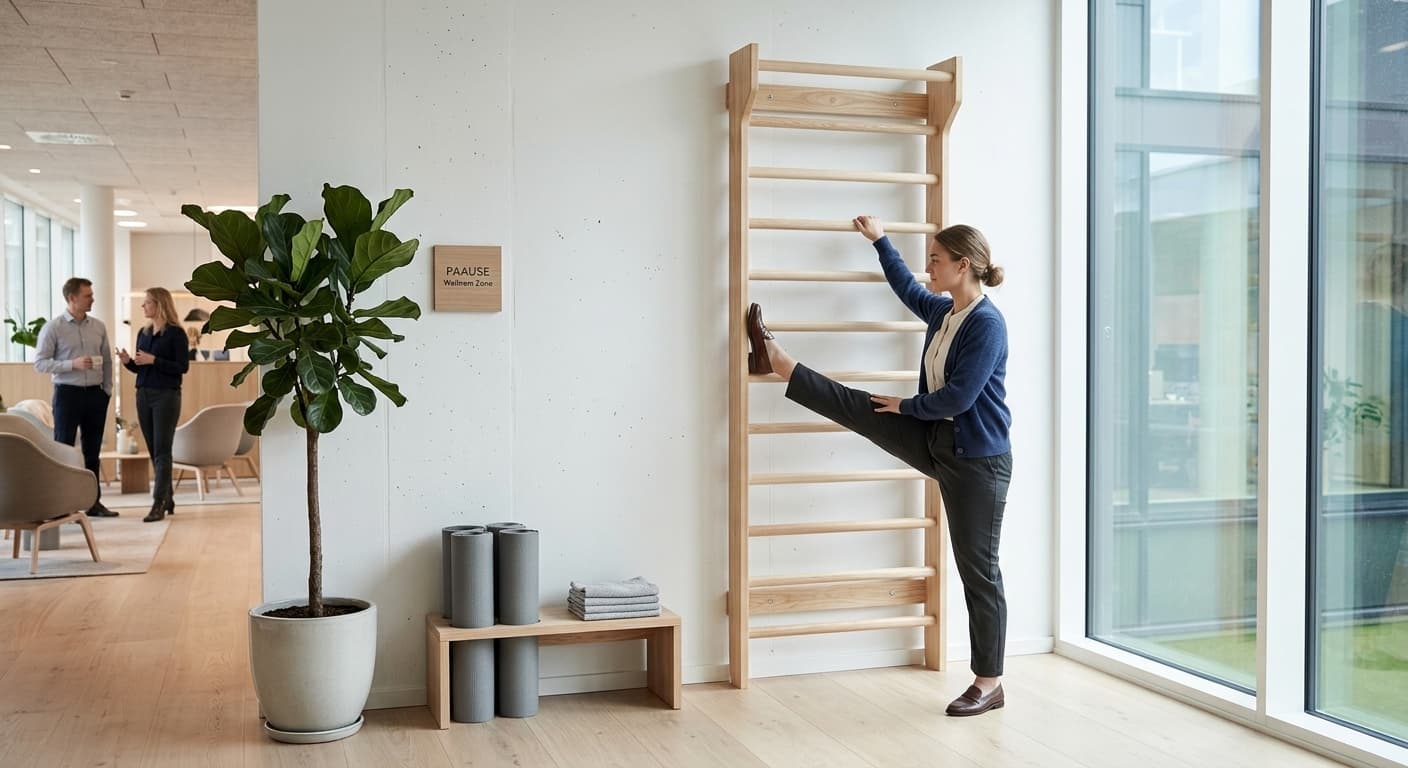
More blood to the muscles. Dynamic stretching and light activation — such as hanging from wall bars, rotating the upper back, and opening the hips — get the muscle pump going and increase blood flow to tense muscles.
Relief for the back. Hanging loosely from wall bars or a bar for 20–30 seconds stretches out the shoulders and back after hours at the screen. If you have shoulder problems, ask the physiotherapist first.
Prevention instead of repair. Musculoskeletal pain is among the most widespread health problems in Denmark and can lead to more sick leave. Regular micro-breaks work as daily maintenance before the damage is done.
The mind gets a break too
From stress to calm. Slow, deep breathing activates the parasympathetic nervous system — the body's rest-and-digest system. One sign is higher heart rate variability. Combined with stretching, it can quiet the mental "noise" that builds up after intense meetings.
Renewed focus. Nobody can sustain full focus for eight hours straight. A short break, when your eyes leave the screen and your body starts moving, restores energy and counters afternoon fatigue.
A culture where breaks are okay. When the workplace makes physical space for recovery, and management makes it clear that a five-minute break is legitimate, it builds a culture where wellbeing and sustainable performance count for more than the most hours in the chair.
From good intentions to a daily habit
Remove the friction. Good intentions die if people have to change clothes, go down to a dark basement, or book a slot. Recovery needs to be visible, inviting, and right where employees spend their day — close to the work and meeting areas.
Make it concrete. Many people don't know which exercises work in just a few minutes. With simple tools such as wall bars and resistance bands, clear exercise guides, and a physiotherapist who visits regularly, getting started becomes easy.
Notice your shoulders and lower back right now. Imagine the difference between a team that goes home tired and stiff at 4 p.m. and a team that gave their bodies and minds two short breaks along the way.
That's the difference a PAAUSE zone is built for: an open recovery zone in the middle of the office, with equipment, exercises, and regular visits from a physiotherapist. Find out what it could look like at your workplace.
Sources
Albulescu, P. et al. (2022): “Give me a break!” A systematic review and meta-analysis on the efficacy of micro-breaks for increasing well-being and performance. PLOS ONE, 17(8), e0272460. doi.org/10.1371/journal.pone.0272460
Andersen, L.L. et al. (2011): Effectiveness of small daily amounts of progressive resistance training for frequent neck/shoulder pain: randomised controlled trial. Pain, 152(2), 440–446. doi.org/10.1016/j.pain.2010.11.016
Dunstan, D.W. et al. (2012): Breaking up prolonged sitting reduces postprandial glucose and insulin responses. Diabetes Care, 35(5), 976–983. doi.org/10.2337/dc11-1931
Jacobsen, S.S. et al. (2024): Vidensopsamling om effektiv forebyggelse af MSB og fysisk nedslidning [Knowledge review on effective prevention of musculoskeletal disorders and physical wear] (in Danish). National Research Centre for the Working Environment (NFA). nfa.elsevierpure.com
Lin, F. et al. (2006): Effect of different sitting postures on lung capacity, expiratory flow, and lumbar lordosis. Archives of Physical Medicine and Rehabilitation, 87(4), 504–509. doi.org/10.1016/j.apmr.2005.11.031
Mairey, I.P. (2026): Absence from the labour market and production loss due to musculoskeletal pain in Denmark (in Danish). National Institute of Public Health, University of Southern Denmark. sdu.dk
National Research Centre for the Working Environment (NFA) (2023): Småøvelser [Short exercises]. Fact sheet (in Danish). nfa.dk
Zaccaro, A. et al. (2018): How Breath-Control Can Change Your Life: A Systematic Review on Psycho-Physiological Correlates of Slow Breathing. Frontiers in Human Neuroscience, 12, 353. doi.org/10.3389/fnhum.2018.00353